Bajirru! there you all are, hello! From the Yanyuwa language of Balarinji’s origin community Borroloola NT
Jinangu awara wabarrangu barra kalu-wingka marnijinju wabudala kari-nguthundawabarrangu jinangu Australia li-wulu marnaji barra liyi-Yanyuwawu awara li-Marranbala li-Arrwangala li-Gudanji jinangu awara Burrulula marnaji yamulhu
Our Country we belong to is Borroloola. Yanyuwa, Marra, Gudanji and Garrawa people.We welcome everyone to this land Australia.
Yanyuwa elder Samuel Evans Jamika
Play sound
Stop play sound
Loading...
Aboriginal and Torres Strait Islander people. are respectfully advised this website contains references, artworks and images of people who have passed
North Western Roads Group

M7 Public Art Collection

Themes

To protect Country is to belong
The overarching theme is ‘To protect Country is to belong’. It places the universal human experience of belonging at the heart of reflecting on the Frontier Wars and Australian war service.

‘Son of Mine’ poem
Celebrates the acclaimed 1960 poem Son of Mine, by Noonuccal woman, Oodgeroo Noonuccal. She was a servicewoman from 1942 after her two brothers were captured by the Japanese in the fall of Singapore. Also known as Kath Walker, the late Noonuccal is renowned as one of Australia’s finest poets. 

Truth telling
Reflects truth telling requested by the community, particularly in reference to the Frontier Wars, to the laws that prohibited Aboriginal and Torres Strait Islander peoples from enlisting, and to the lack of entitlements for Aboriginal and Torres Strait Islander veterans returning to civilian life. 

Narratives

Frontier Wars 

The Art Collection narrative begins with the Frontier Wars fought by Aboriginal and Torres Strait Islander peoples to hold and care for traditional Country. 

Interconnection

Next, the narrative honours Dharug matriarch Maria Lock, whose family fought in the Frontier Wars, her marriage to convict Robert Lock and their nine surviving children, from whom many Dharug people descend. Maria’s descendents fought in the World Wars and today they continue to uphold and enrich Dharug culture.

Together at war

The next works acknowledge the furnace of World Wars where Indigenous and non-Indigenous soldiers fought together in a relationship of equality to protect Australia. 

Service and reconciliation

Finally, the story recognises how the spirit in which positive relationships were forged in war gives us hope for a reconciled, entwined future for Australia.

Public Art Components

Co-created by Balarinji Studio with a cohort of locally-connected Aboriginal artists, the M7 Public Art Collection features 12 artworks and interpretive elements that authentically honour Aboriginal cultural knowledge, protocols, history and contemporary stories through the overarching theme, ‘To protect Country is to belong’.

Frontier Warriors

Co-created by Jamie Eastwood (Ngemba/Dharug) and Balarinji Studio

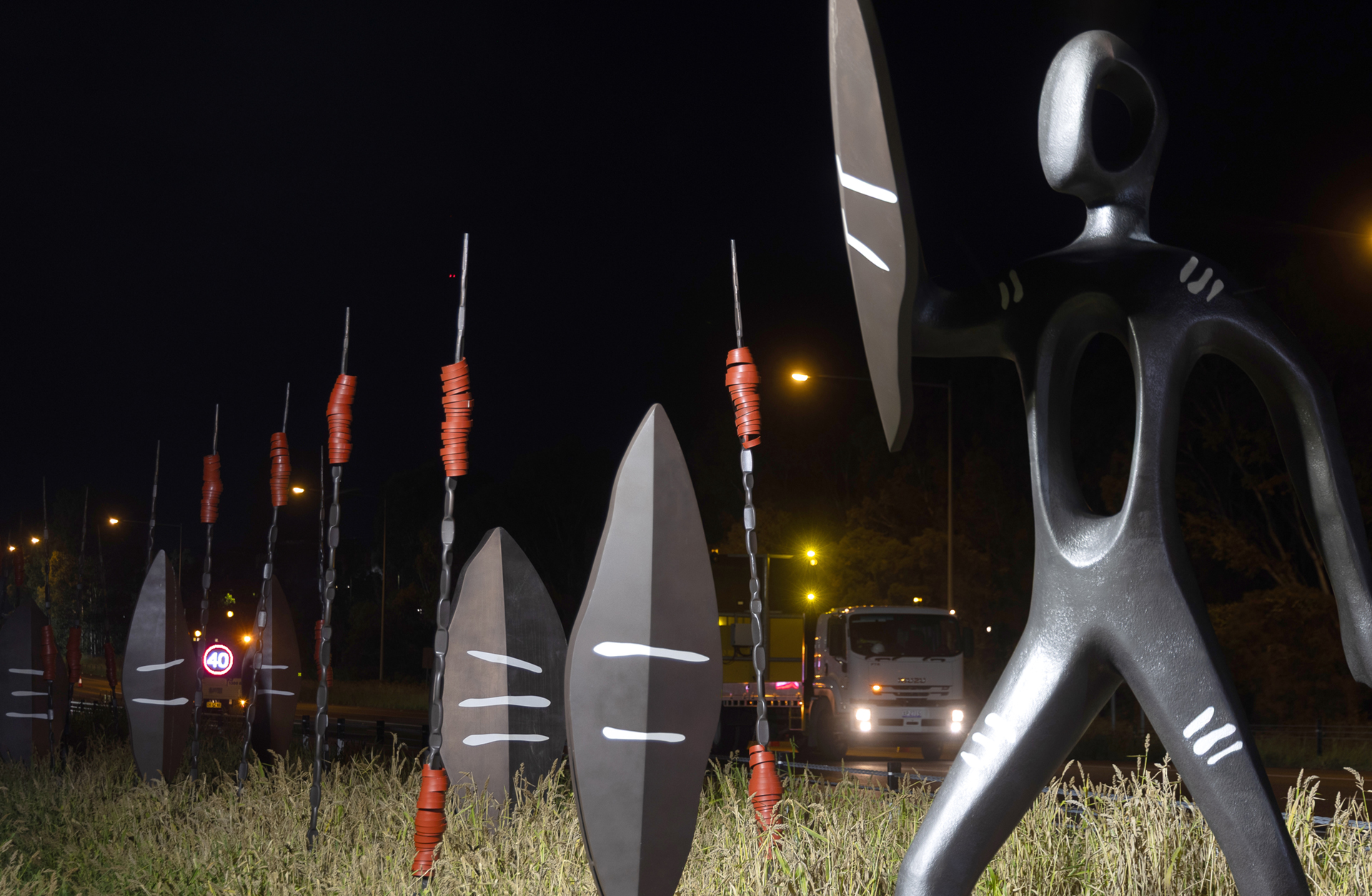
The Frontier Warriors artwork honours the spirit of the warrior, a custodian who stood firm on Country, protecting land and kin as was their Law responsibility. It reflects the pre-colonial landscape and ecology of Western Sydney and a conflicted Australian past at the point of colonisation.

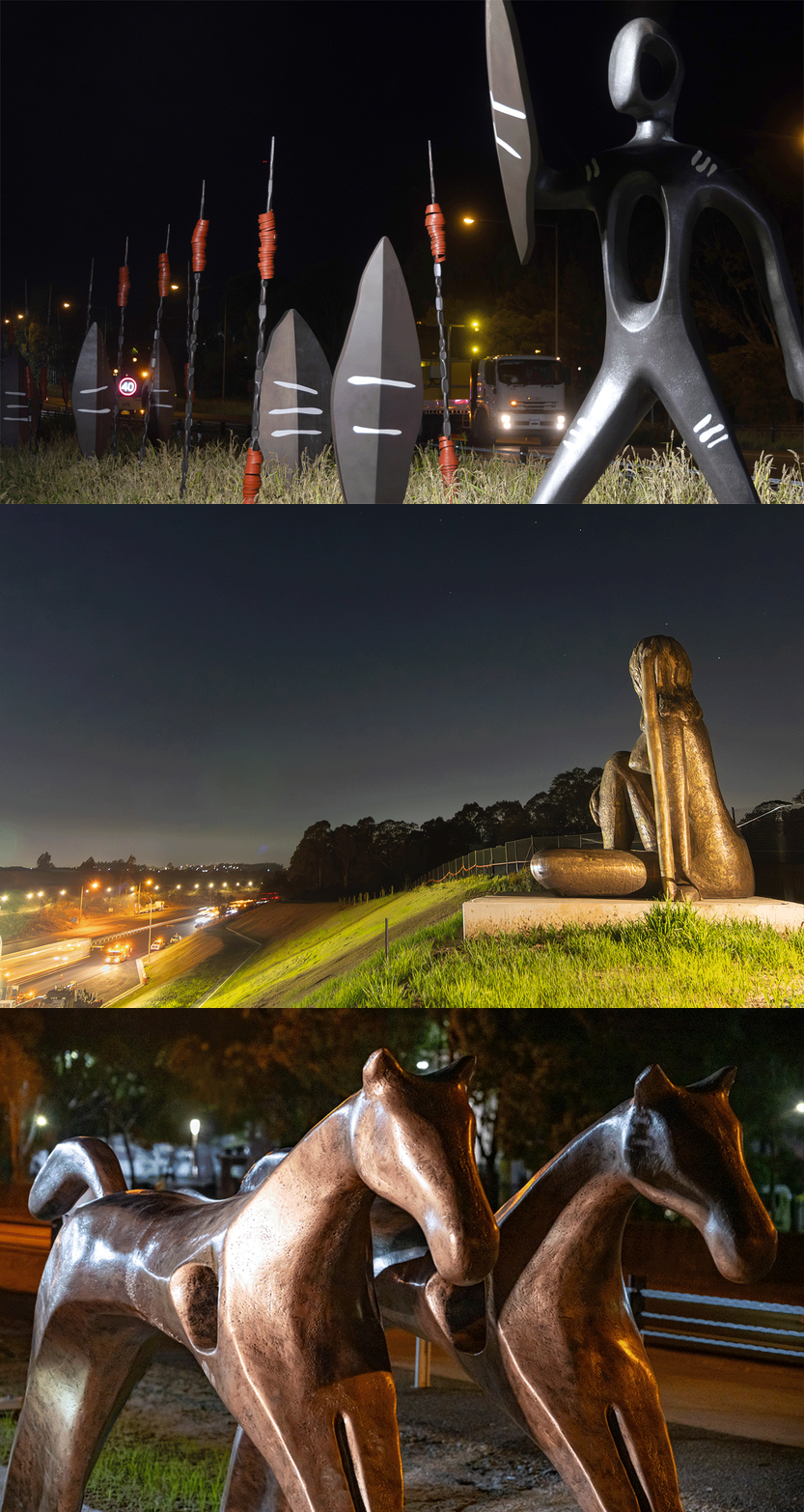
The work is a collection of metallic shields and spears, with three warrior figures, standing approximately four metres tall. Each warrior and shield features reflective markings to represent ceremonial body paint, making them visible in headlights at night.

The warrior, spears and shields symbolise battle, resilience and strength as well as enduring belonging and custodianship, honouring the legacy of those who defended their Country with courage and commitment.

Maria Lock with Robert on Dharug Country

Co-created by Jasmine Seymour (Dharug), who celebrates being a descendant of Maria Lock, and Balarinji Studio. 

These two large bronze sculptures honour Dharug matriarch Maria Lock (c.1805-1878) who broke barriers in education and in pursuing Aboriginal rights. It references her marriage to convict carpenter Robert Lock and their nine surviving children, from whom many Dharug people descend.

The M7 Public Art Collection narratives are interconnected through Maria’s story; her family who fought in the Frontier Wars, her descendents who fought in the World Wars and her descendants today who continue to uphold and enrich Dharug culture.

Bayala Guwiyang (Yarning Around The Fire)

Co-created by Jamie Eastwood (Ngemba/Dharug) and Balarinji Studio. 

Bayala Guwiyang artwork symbolises coming together in hope and reconciliation. It represents the remarkable bonds of camaraderie and trust forged between Aboriginal and non-Aboriginal servicemen on the battlefield.

The reflective black, white and orange poles with Gymea lily line work, refer to black and white servicemen gathered around a central campfire. The artwork evokes the concept of gathering, even amid conflict, through shared experience.

The poles are made from cast aluminum with a reflective finish, making them visible in headlights at night.

Son of Mine, Poem, Oodgeroo Noonuccal

Created by Balarinji Studio. 

Son of Mine installation is the last verse from the acclaimed 1960 poem, “Son of Mine” by Noonuccal woman, Oodgeroo Noonuccal (also known as Kath Walker), one of Australia’s finest poets.

I’ll tell instead of brave and fine,
When lives of black and white entwine

The artwork reflects a shared mission to protect Australia with bravery and honours the spirit of cooperation, mutual respect and belonging shown by black and white servicemen coming together in the furnace of war.

Gili (Light)

Co-created by Jamie Eastwood (Ngemba/Dharug) and Balarinji Studio. 

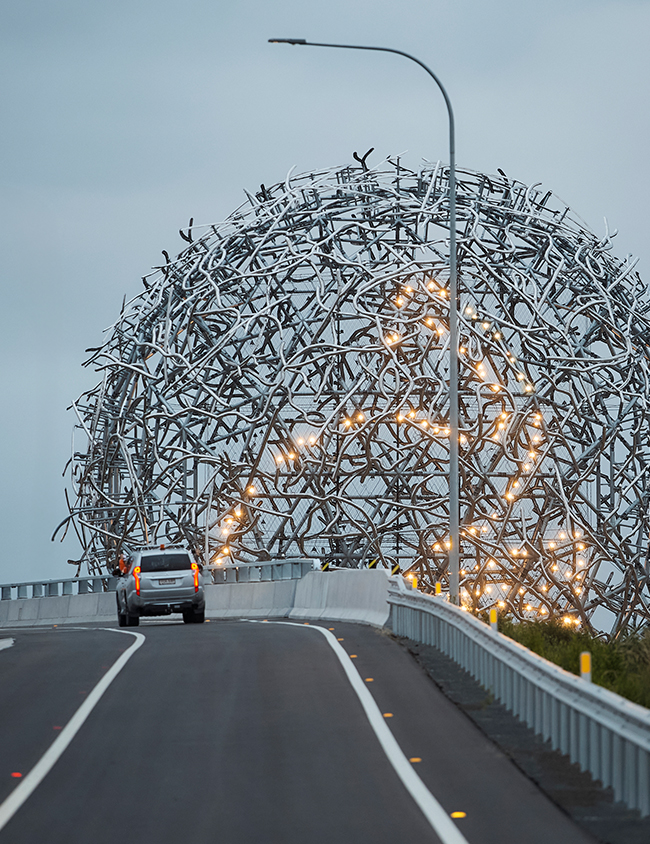
The 50 metre tall Gili artwork was inspired by the Gymea Lily, a symbol of fire on Dharug Country. Gili in the Dharug language means light.

Through the idea of sharing a campfire, the artwork represents unity in diversity of Western Sydney cultural groups living under one sun.

Situated at the M7/M12 Interchange, Gili will be illuminated with seasonal colours that reflect the Aboriginal six seasons of Western Sydney.

New Light Horse Interchange artworks

Co-created by Jasmine Seymour (Dharug) and Balarinji Studio

Known as the Light Horse Interchange, the Light Horse installation is a story in two parts. The existing Colin Polwarth work (2007) tells the story of horses left behind when servicemen returned. The new Indigenous artworks tell the story of Aboriginal and Torres Strait Islander service in connection with the Light Horse.

Military Horses
This artwork comprises 20 horses, each one standing two metres high, positioned on either side of the interchange.

These sculptural horses pay tribute to the Aboriginal and Torres Strait Islander soldiers who took horses to battlefields and recognises Aboriginal and Torres Strait Islander horsemanship skills honed in Australia’s emerging pastoral industry of the early 1900s.

Emu Plumes
The emu plumes reference Colin Polwarth’s existing work and note the significance of the emu to Aboriginal ceremony and Country, as well as the commonality and mateship of the iconic slouch hat.

The eight stainless steel plumes stand 2.5 metres tall, preceding the horse formation on either side of the interchange.

Signage and interpretive elements

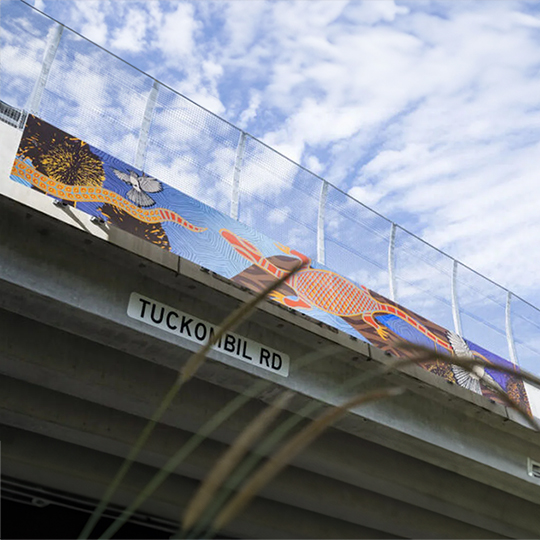
Designed by Balarinji Studio, the signage, wayfinding and interpretive markers throughout the renewed section of the M7 Motorway feature graphical elements from the M7 Aboriginal artworks to illustrate the storytelling and deepen the corridor’s connection to Country.

Signage featuring Dharug language conveys messages of welcome and safe travels, such as Budyari Dharrabarra (have a good day).

Shared path experience

The interpretive approach for the shared path reflects the themes and narratives of the M7 Public Art Collection. It incorporates rest stop artworks and interpretative elements that celebrate Aboriginal practices, such as weaving and carving, as well as wayfinding markers.

Frontier Warriors - Spears

Co-created by Jamie Eastwood (Ngemba/Dharug) and Balarinji Studio.

The Frontier Warriors artwork is continued at the Bernara Road rest stop in the form of two warrior spears. These spears stand as powerful symbols of the resistance and resilience of Dharug warriors.
The artwork acknowledges the Aboriginal people who fought for Dharug Country during the Frontier Wars. It reflects the pre-colonial landscape and ecology of Western Sydney and a conflicted Australian past at the point of colonisation.

The work represents resilience and strength as well as enduring belonging and custodianship, honouring the legacy of those who defended their Country with courage and commitment.

Dyuguma (Dilly Bag)

Co-created by Corina Wayali Norman (Dharug/Dharawal) and Balarinji Studio.

The cast bronze sculpture of a dilly bag and native currants is a symbol of women’s roles in sustaining communities and ensuring the survival and continuation of cultural practices, like gathering food and healing.

Dilly bags and baskets were traditionally made on Country using a weaving style that continues to be practiced today. Used for collecting food, this dilly bag representation holds native currants, a vital food source with potent medicinal properties, commonly used as an antiseptic to treat wounds and sores.

This work reflects the idea of sustainability through caring for Country, a practice inherent to the way Aboriginal peoples lived, purposefully hunting and gathering only what was needed to feed their families.

Rest Stop Inlays

Sun, Moon, Coming Together
Co-created by Jamie Eastwood (Ngemba/Dharug) and Balarinji Studio.

The Sun, Moon, Coming Together ground inlay, located at the M7/M12 interchange rest stop, symbolises the unity of all cultures and communities coming together under the same sun.

Poppies
Co-created by Jamie Eastwood (Ngemba/Dharug) and Balarinji Studio.

The Poppies ground inlay, located at the Motorway Control Centre rest stop, reflects the meaning of flowers for Aboriginal peoples, indicating seasonal change and sustainability. The poppy is also a symbol of remembrance for soldiers who have fallen in war.

Ngaya Ngurra (My Country)
Co-created by Jasmine Seymour (Dharug) and Balarinji Studio.
The words of the ground inlay at Dobroyd Drive Rest Area, Ngaya Ngurra, mean My Country in the Dharug language. This work represents caring for and sustaining Country. The Dharug language is an essential component of keeping culture and knowledge alive.

Bayala Guwiyang (Yarning Around The Fire)

Co-created by Jamie Eastwood (Ngemba/Dharug) and Balarinji Studio.

The Bayala Guwiyang artwork is continued at the Villiers Road rest stop. The two cast aluminium poles, one black and one white, represent the unity between black and white soldiers on the battlefield, the truth telling of Aboriginal war service, the significance of fire in caring for Country and as a symbol of courage forged in the furnace of battle.

Accompanying this artwork on the shared path are candid post-war accounts from Aboriginal and Torres Strait Islander servicemen about the injustices they faced and their struggle for equality and inclusion on returning home.